My Gourd Banjo
My gourd banjo is my first woodworking project that I made in the winter of 2025. He's a semi-traditional folk gourd banjo made out of a cherry neck and a Georgia-grown gourd with a goatskin head, an ebony nut, and custom cherry pegs, bridge, and tailpiece. He currently has on Aquila red nylon strings.
It's not a perfect instrument, but I loved making it, and love that it's a functioning piece of art that I created. I don't name my instruments, but my coworker insisted that if I didn't name it, his name would be Gordon, so Gordon is his name.
Here are some resources on banjo making that were essential for this project:
- Ben Greco: The single primary source I constantly followed and referenced for this project. None of this would've been possible without him.
- Piccolo Place: Great website with Banjo history that let me play with scale length and conceptualize sizing. Highly recommend this site just to explore.
- Rudy's Overview of building a Banjo: I didn't use this enough, but it was a great read.

For an in depth blog post about how this instrument was made, check out this blog page.
Handy Reference Chart
This reference chart is potentially cursed and incorrect in some ways, but it's been an extremely helpful reference for me while improv playing.
I realized that you can capo the banjo at various frets, and all the chord shapes work but end up being different chords. Without a capo in standard tuning, the C shape plays the 4th of the G scale (C), and the D shape plays the 5th (D). You can take this, move the capo to other frets, and play using the same chord shapes to sound good within the called for key. So someone could tell me to play in the key of D, and I'd know I can move the capo to the 7th fret and play the 4th (G) and 5th (A) of that scale.
This system is incredibly basic, and I am no master of music theory, but 's been a great tool to quickly play on top of really any piece (once I get the key!).
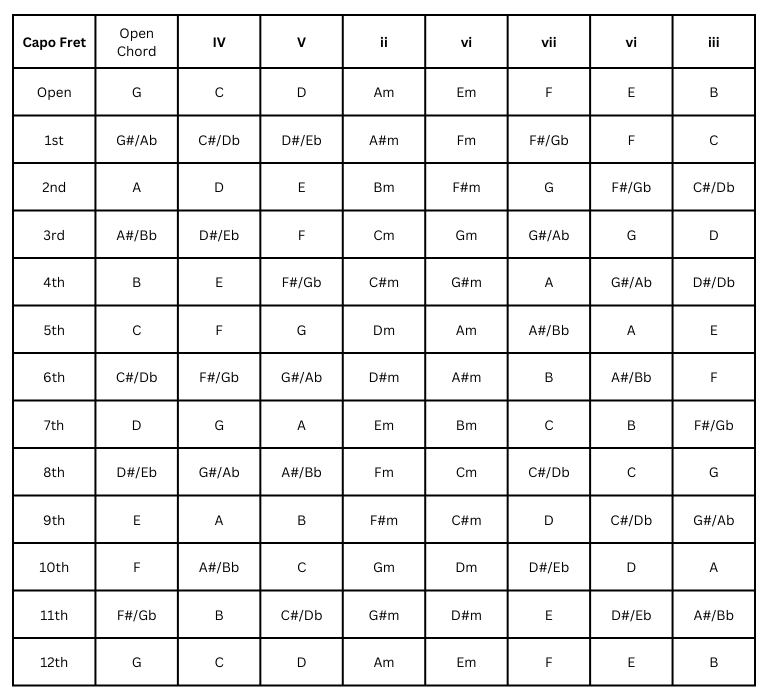
Since finding this, I've found this system is a version of the Nashville Number system, but I'll keep it here as it's easy reference for me.
Banjo Tunings
There are a lot of tunings to learn while using the banjo! I think it's because none of us can be in key well enough to play complex chords. Here are the main tunings I tend to use
Regular Tunings
These are the tunings that are versative and play multiple songs.
| Name | Tuning | Notes |
|---|---|---|
| Standard | gDGBD | Start here! |
| Sawmill | gDGCD | AKA G-Modal or Mountain Minor |
| Double C | gCGCD | Lowkey the best tuning? |
| Standard A | aEAC#E | |
| A Modal | a/gEADE | |
| Double F# | f#F#C#F#G# | Stellar really low tuning I use on my goard banjo |
Song Tunings
Tunings that are only for the specific song in the name
| Name | Tuning | Notes |
|---|---|---|
| Ramblin Hobos | fCFCD | AKA Last Chance |
| Shavin a Dead Man | g#BEBE | |
| Back Step Cindy | aDADe | Double D |
| John Riley the Shepherd | a/gEADE | A Modal |
| June Apple | aEAC#E | A Standard! |
| John Brown's Dream | ||
| Blackest Crow | AKA As Time Draws Near | |
| Reuben | g#EG#BE | playing in E from A |
| f#DF#AD | playing in D from G |